The Negotiator & Post-idyllic landscapes
An international group of artists, representing the allied forces, reflected on the Great War. The works are taken on an exhibition tour, and shown at important places at the former front line in Belgium and France. Emily Kocken participates as a representative for the United States of America with five works:
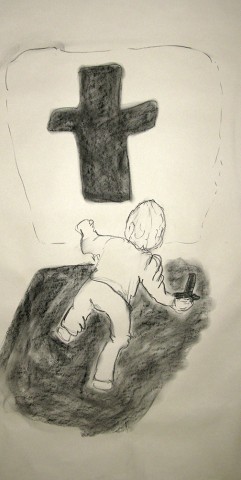
The Negotiator
drawing
Based on the Goya etching Disparate allegre, Proverbios 12, the key figure in this image, a large man seen on the back is paraphrased and transformed into the child he once was. Isolated from his co-dancers, the movement he seems to make with his fist, a silly dance move, receives a different meaning. Is the boy playing a game, provoking the large cross opposing him, while the cross casts a shadow on his future life?
The negotiator is the first sketch of a work in progress, in which key figures of Goya’s allegre are isolated and varied upon.
The Caretaker
collage [blanc photo negative, ink, typex, pencil on paper]
A comment on the famous pro war posters that called on women to let their men go to war, expressing archetypal female and domestic roles in a single image.
‘There were two camps in feminist circles at the time, one in favor of the war, and one protesting and even organizing a peace convention in The Hague. I have tried to capture this duality of women’s behavior during the war.’
Bows and bodies
drawing [pencil/typex on paper]
‘One of the motives in my work are bows, cup sleeves, pleaded skirts. Girlish garments and embellishments, symbols of hiding and being bound.
In this drawing, based on different amateur photographs of dead soldier bodies lying in the trenches, I created an fictitious scene: a small group of female bodies, some of them pregnant, wrapped in ribbons, still moving. The big bows floating above their faceless heads, ambiguously, witnessing but passive, threatening as a force of nature, like low hanging rain clouds.’
Post-idyllic landscapes
photography
In the mountains of Berner Oberland lie carefully hidden military bases. The landscape shows little clues in the form of small outdoors shooting ranges.
The trees and rocks echo solemnly the neutrality of the Swiss landscape.
‘During many walks in the mountains these ranges kept popping up. Many Swiss men are shooters, as a hobby and because of the large reservist army. It is a non characteristic of this country, associated by the public with a anti-war position. The knowledge of this considerable amount of army bases, changed my experience of the landscape forever. Not a guilty landscape per se, but more of one that masks what is really going on. There is a darkness there that is hard to capture in words.’
See invitation on www.ijzertoren.org →